Leaders often see activity in a training event: meetings, briefings, products, and discussion. What is harder to see is the thinking behind the recommendation. CADE was built to make that thinking visible quickly, without needing heavy simulation equipment or a long setup period.
Capstone project Ongoing
CADE — Combined Arms Decision Exercise
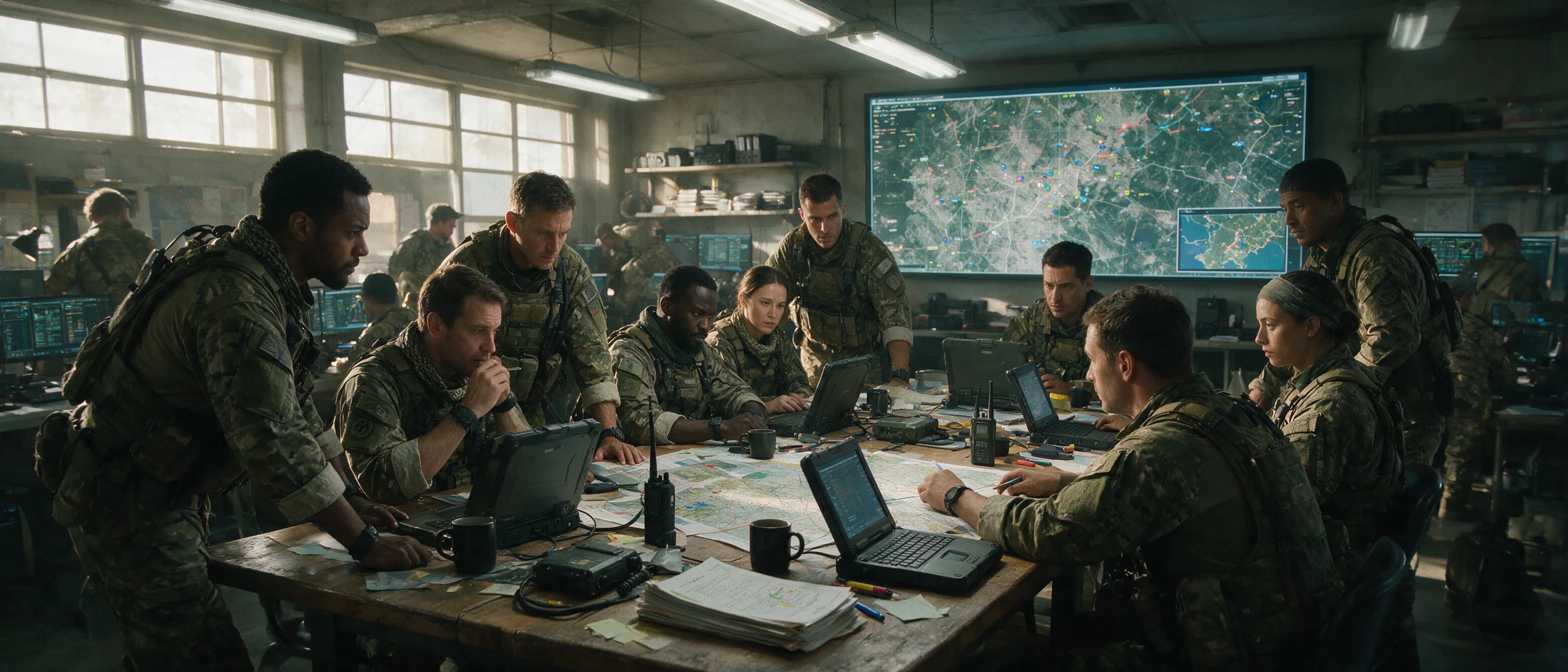
CADE shows how a team thinks under pressure. I developed the first executable version in one week; it has now run three times with about 19 participants per session.
Where this fits
This is the system centerpiece.
CADE is the flagship NextGen Wargame case study. It demonstrates the full operating model: source truth, turn rhythm, adjudication structure, controller usability, and execution evidence.
Project Proof
The useful version first.
Every project is framed as a problem, design move, built system, supporting workflow, evidence set, and transferable skill.
I treated CADE as a governed production system, not a one-off exercise script. OPORD-quality source truth constrained every generated artifact; human design authority set the success criteria and review gates; execution evidence, not document polish, decided what changed next.
I built a repeatable controller-facing exercise system: source-governed scenario material, a fixed turn engine, adjudication bands tied to observable staff behavior, learning capture, and a five-document Controller Package that gives controllers the prompts, timing, role aids, and review structure needed to run the event.
Controller Package Generator
Turns an OPORD into a master turn list and phase documents so controllers can execute from a coherent runtime package.
OPORD-to-turn-package workflow
Keeps situation updates, decision prompts, adjudication triggers, and consequence state traceable to the approved source order.
Source-truth review workflow
Rejects or revises AI-assisted outputs that drift from approved scenario logic before they enter execution products.
Adjudication support model
Maps observable staff integration behavior to outcome bands so consequences are consistent without removing controller judgment.
Briefing/deck workflow
Uses editable Markdown sources and PPTX/HTML outputs to keep briefs reviewable and fast to revise.
Gap-filling production workflows
Creates reviewed op-boards, annexes, and briefing outputs when incomplete unit inputs would otherwise stall production.
First executable version
I developed the initial executable CADE in one week.
Repeated live use
CADE has run three times with an average of about 19 participants per session.
First-run validation
Four validation criteria were met on the first execution: staff operated inside the structure, controllers executed with delivered artifacts, consequences created pressure, and review captured learning.
Evidence-driven product change
Fragmented first-run artifacts led directly to the unified Controller Package architecture for later versions.
No heavy simulation dependency
The event delivered decision-quality staff practice without JCATS, DXTRS, or comparable simulation infrastructure.
CADE shows I can take an ambiguous training problem, impose a production model, govern AI outputs, build the supporting tools, validate the product in execution, and turn evidence into a more usable system.
Deeper Detail
CADE is a controlled turn cycle for training staff decisions. Each turn gives the staff enough context to act, forces a choice, captures the reasoning, shows the result, and turns that result into a review point. I designed and built CADE, used AI to move faster, and kept the design and validation under human control.
Operating Constraints
- Training time is compressed, so preparation overhead cannot consume the event.
- Participant proficiency and doctrinal familiarity may vary across the staff.
- Mixed-language delivery requires plain-language phrasing and visual-forward support.
- Controllers need runtime products that work under pressure without designer dependency.
- AI output must remain subordinate to source truth and human design authority.
Production Approach
The work started with problem framing and acceptance criteria, then moved through source-package construction, bounded AI-assisted drafting, human review, trainer feedback, live execution, and evidence-based redesign. AI accelerated research, drafting, artifact generation, and revision; it did not decide the training logic, approve source material, or determine post-execution changes.
AI Operator Skill Demonstrated
- Framed the training problem before generation began.
- Constrained outputs with source truth, acceptance criteria, and human review gates.
- Designed the production chain around controller usability, not just document completion.
- Converted live execution evidence into the Controller Package architecture.
Turn Rhythm
Situation
Establishes the operational update and decision context for the turn.
Clarification
Allows the staff to resolve essential uncertainty before deliberation begins.
Deliberation
Forces cross-functional coordination and tradeoff discussion inside a time box.
Decision
Requires explicit commitment instead of deferral or open-ended discussion.
Brief to CDR
Turns staff reasoning into a commander-facing recommendation.
Adjudication
Applies consequences and sets conditions for the next turn.
Product Architecture
Source-governed scenario package
Maintains scenario narrative, operational graphics, control measures, and annex logic as coherent source truth.
Controls AI drift by forcing every downstream product to trace back to an approved source layer.Turn engine
Defines the decision rhythm, phase transitions, time boxes, and required staff commitments.
Turns training intent into repeatable workflow logic that AI can support without changing the exercise purpose.Adjudication model
Connects observable integration behavior to outcome bands so consequences are credible and comparable.
Converts qualitative staff behavior into structured decision support without outsourcing judgment to vague impressions.Controller delivery package
Consolidates execution logic, role aids, decision prompts, timing cues, and review support into one runtime artifact.
Designs AI-produced artifacts for real human use under time pressure.Learning capture layer
Structures turn-level review so reasoning, expected outcomes, coordination gaps, and next adjustments are captured.
Closes the loop between AI-assisted production, live execution, and evidence-driven iteration.Key Decisions
Use AI as the production engine, not the design authority
Reasoning:
AI made speed possible, but the exercise required human judgment to define the training problem, approve source material, set success criteria, and decide what changed after execution.
Alternatives considered:
- Let AI generate the exercise structure directly
- Use AI only for editing and formatting
Anchor all products to OPORD-quality source truth
Reasoning:
A single authoritative scenario layer reduced drift across orders, turn materials, controller prompts, and review products.
Alternatives considered:
- Allow each artifact to evolve independently
- Use loose narrative summaries as the source layer
Move from fragmented runtime artifacts to a unified Controller Package
Reasoning:
Controllers need fast, reliable access under pressure. Consolidating execution logic, role aids, decision prompts, and review structure made the framework more portable.
Alternatives considered:
- Keep the runbook as the center of gravity
- Use separate support products for each controller function
Use deterministic adjudication bands tied to observable behavior
Reasoning:
Controller-to-controller variance weakens outcome credibility. Observable bands reduce discretionary drift while preserving human oversight.
Alternatives considered:
- Let controllers adjudicate primarily by judgment
- Use fully scripted outcomes detached from staff behavior
Use plain-language and visual-forward delivery
Reasoning:
CADE must work when language friction is present. Plain wording and visual aids reduce avoidable misunderstanding without diluting the training logic.
Alternatives considered:
- Keep doctrinal language dense and assume translation will solve it
- Simplify the exercise itself instead of improving delivery aids
Tech Stack
- Claude
- ChatGPT
- Gemini
- Markdown
- PPTX/HTML briefing workflows
- OPORD-grounded planning workflows
Result & Impact
- 3Live executions
- ~19 per sessionAvg participants
- 1 weekTime to first executable version
- 4 of 4 on first executionValidation criteria met
- 5 documents, zero simulation infrastructureController Package
CADE proves the operating model: disciplined AI production, source governance, controller-facing tooling, live validation, and evidence-driven iteration can turn a compressed training requirement into a usable product.
Additional Evidence Signals
Staff operated inside the structure
Confirmed across all three executions. S1, S2, S3, S4, XO, Medical, Engineer, Fires, and additional staff positions operated inside the framework without designer support during turns.
Controllers executed with delivered artifacts
Confirmed on first execution. Identified fragmented artifacts as a failure point — led directly to the unified Controller Package architecture in subsequent runs.
Consequences created meaningful decision pressure
Confirmed. Resource depletion, casualties, timing constraints, and degraded options from earlier turns visibly shaped staff behavior in later turns.
Review captured learning before the next cycle
Confirmed. Protected AAR windows held across all sessions. Execution observations fed directly into the v3.0 redesign.
Where CADE Fits
- Training time is compressed and setup overhead must stay low.
- The primary objective is decision behavior under pressure.
- The staff needs to practice cross-functional integration, not isolated section work.
- Language friction or uneven proficiency is present or anticipated.
- The event owner needs a repeatable format that can be facilitated from a Controller Package.
Designed Against Failure Modes
Role boundaries, pre-execution guidance, and the Controller Package keep facilitation behavior constrained.
Outcome bands and observable behavior categories reduce discretionary variance.
OPORD-quality source truth governs every downstream product.
Plain-language phrasing and visual-forward aids reduce avoidable comprehension burden.
Persistent state tracking keeps resources, timing, casualties, and option degradation connected across turns.
Boundaries
- CADE does not replace high-fidelity simulation when technical modeling is the primary objective.
- CADE does not certify doctrinal competency or grade students on a pass/fail basis.
- CADE does not fully automate design judgment through AI.
- CADE is strongest when the desired outcome is decision behavior under constrained conditions.
Learnings
- The operator's highest-value work is framing the problem, source constraints, acceptance criteria, and review gates before production starts.
- A training product is not finished when the documents look complete; it is finished when controllers can use it under pressure.
- Execution evidence is stronger than document-only review for deciding what the product needs next.